On Communication, Community & Play

On Communication…

I recently collaborated with some friends to co-facilitate two twitter space conversations about compassionate communication.  The first one we did was an overview of compassionate communication/non-violent communication (NVC) and active listening, and it was great to review Marshall Rosenburg’s book in preparation for the conversation. In the book, non-violent communication is described as a process where “instead of habitual, automatic reactions, our words become conscious responses based firmly on awareness of what we are perceiving, feeling, and wanting.” When I read this description I feel inspired, because I value clear communication and connection :)

In the first twitter space conversation, I shared about the four components of compassionate communication which are observations, feelings, needs and requests.  The first component of ‘observations’, can be defined as the concrete actions we observe that affect our well-being.  Instead of communicating from a place of observation, we often make evaluations of one another, which seem to more likely lead us to misunderstanding/conflict.  There is a quote from J Krishnamurti in this section of the book that says,“the ability to observe without evaluating is the highest form of intelligence.”  Along these lines, a friend of mine shared with me recently that she doesn’t believe in intuition in the way many people think of it, but that she believes intuition is actually acute observation.  I think this is an interesting perspective to consider, and can invite us deeper into observation and being truly present to what is.  

I’m not going to go into all of what we discussed in the conversation as it pertained to feelings and needs, but I do want to share a couple of things about ‘requests’ that I find to be helpful in communication.  In the NVC book, Marshall shares that oftentimes, we are simply not conscious of what we are requesting when we speak, and that we talk to others or at them without knowing how to engage in a dialogue with them.  There is beauty in the creativity and vulnerability in making requests of one another, many ways we can co-create win-win scenarios that are enriching for all involved.  In this same vein, I also appreciated the reminder in the book to use positive action language to state what we do want rather than what we don’t want when making requests.  

The second conversational space we did was called “Making Friends With Ourselves: The Path of Self-Compassion”, and in preparation for it, I spent time reviewing Kristin Neff’s website.  I am not related to Kristin Neff, but it’s an honor to share a name with her because she is great and I love what she is all about! In the conversation, we talked about self-compassion as the path to befriending ourselves, offering ourselves the same kindness and care we’d extend to a good friend.  Self-compassion is about honoring and accepting our humanness, to recognize the human condition shared by all of us.  In the conversation, we talked about Kristin Neff’s research around self-compassion; the three components of self-compassion (self-kindness, common humanity and mindfulness), as well as what self-compassion isn’t (self-indulgence, self-pity, and self-esteem).  All of this richness can be further explored on Kristin Neff’s website.  After I helped to frame the conversation with some of these ideas, we opened it up to a dialogue and people from different parts of the world shared their insights and experiences with self-compassion.  I viscerally felt our common humanity on the call, as people from India, Dubai, the UK etc. shared similar struggles and experiences. 

I consider the practice of self-compassion to be a process of inner communication, which reminds me of a quote from Thich Nhat Hahn’s book “The Art of Communicating” that says, “once you can communicate with yourself, you’ll be able to communicate outwardly with more clarity.  The way in is the way out.”  I’m sharing about self-compassion in the context of communication, because I believe the practice of self-compassion paves the way for us to have clear and compassionate communication with one another.  

On Community…

I had several conversations this past month about the differences between co-dependence, independence, and interdependence.  I understand a codependent relationship dynamic to be one in which there is an over-reliance on the other/one another and over-identification with the relationship.   I don’t use the word co-dependence much anymore, but reading and learning about codependence has been helpful to better understand relationship patterns I have been a part of creating in the past.  

Independence lies on the other end of the spectrum, and is evident in our western culture that values individual freedoms over togetherness.  While self-sufficiency and self-responsibility are important to building healthy relationships, we can cooperate and support each other while maintaining responsibility for ourselves.

Interdependence is about finding freedom in togetherness, in community.  In this way, we can approach community as a pillar of interdependence, recognizing that community means re-learning how to be in right relationship with all beings.  Interestingly, I learned from a dear friend this past month that the word ‘freedom’ comes from the Old English word ‘freon’ which means beloved, friend and/or to love.  It’s cool to think of friendship and freedom as etymologically synonymous! May we all experience freedom in friendship, celebrate togetherness in community, and learn to care for one another and for ourselves simultaneously.

I feel grateful to be settling into a wonderful community these days, after a year and a half of moving around living in different places, which although involved time living in sweet community contexts, also involved long solo drives and quite a lot of time alone.  Community holds us, grows us, and stirs the pot in sometimes uncomfortable ways.  I have been experiencing new levels of vulnerability as I build community here and nurture newer relationships-and I’m so here for it! It feels like a continual opening which can feel scary, and I sometimes feel myself contract.  In those moments I focus on staying open, on softening, and shifting to a place of curiosity, patience and compassion.  I strive to practice loving speech and deep listening, which Buddhist teacher Thich Nhat Hanh teaches are key to community building.

In thinking about community, I’ve been reflecting back on an online course I took last fall offered through the Tamera Peace Research and Education Center to study their Healing Biotopes Plan.  Tamera teaches that…“Healing Biotopes are small-scale experimental centers in which people research how to build peace culture.  They are models that are scalable and replicable, working on lived, embodied information that can contribute to the DNA of a nonviolent civilization.  Ultimately, a Healing Biotope is a place where all beings live together in full cooperation and unreserved trust.”  

I loved learning about Healing Biotopes last year, and dream of these places proliferating throughout our world.   Community in itself holds the key to getting us there, so focusing our efforts on nurturing relationships and building communities of trust is essential.  Tamera teaches that part of building community is learning to think together, and that we learn the laws of peace by learning the logic of community.  I love the idea that creating peace happens through the active, dynamic and challenging process of community building.

I also appreciate that Tamera teaches that community acts as the “basic social organ of humanity, and the foundation of a natural ethics of mutual support, solidarity and trust.  The community is a unified organism and the individual people are its organs.  As the new organism emerges, a new mental-spiritual subject develops: the communitarian ‘I’.”  The living systems nerd in me loves thinking about community as the collective organism and individuals as the organs, each person playing their vital role in the makeup of the whole.  

On Play…

Grappling with the war in Ukraine, and with the suffering and uncertainty in our world and our own lives, it can be challenging to find levity and play amidst it all.  Over the last few months, at times when I have felt joy, I have also felt coupled with it, something akin to guilt.  When I dig deeper into this, I realize the complexity of this emotion comes from a place of recognizing how lucky I am, mixed with a feeling of overwhelm in truly facing and being with the suffering in the world, with a desire to help alleviate suffering in the world and confusion in not knowing quite how.  

For years, I was fixated on finding my ‘purpose’ which felt like being stuck in a place of rumination and insecurity.  I realize now that the simple act of presence is a gift, and that when we surrender into the joy of being, we change the world for the better.  Play is a portal into joy that requires our presence, and when we allow ourselves to play, we beautifully recreate the world around us.  Also, play can be a rebellious and subversive act~which is something I plan to further experiment with and explore :)
On Death, Identity & Money

On death…

I had a vivid recently where I was on a plane and we were flying over somewhere cold, in the dream it seemed to be somewhere in northern Europe.  When it came time to land, the flight attendant announced that we were preparing for landing and we began to descend.  We encountered a lot of turbulence and then all of a sudden we crashed straight into the ocean.  It took a moment for everyone to realize what had happened, and then it became clear that we were underwater and that the plane would soon be filling up with water and that there was no way out.  In the dream, I had the realization that I was going to die and as many people around me on the plane began to panic, I closed my eyes and went into meditation, breathing deeply and accepting that I was going to die soon.  When the dream reached the apex of intensity, I woke up.  I promptly began scrolling on instagram and made myself a sweet treat, a little bowl of cashew yogurt and peanut butter.  I was up for several hours feeling distraught, and as I was getting ready to get a second bowl of yogurt and peanut butter I realized that I was eating from a place of anxiety, distracting myself to cope with the stress of the dream. 

The next day I told a friend about the dream, and he then shared with me his own journey of getting to a place of accepting the inevitability of death, and that he has been able to recognize that death is not personal, that it just is.  This friend then went on to share his belief that the shift into true adulthood is marked by accepting the certainty of death.  I think there is a lot of wisdom in this, and although I don’t think I’m there yet, the dream did illuminate how the fear of death in my subconscious may be ruling certain unhelpful or irrational behavior.  In line with this thinking about death, I also appreciate the Buddhist philosophy on death, and as the recently departed great Buddhist teacher Thich Nhat Hanh wrote, “the Buddha taught that there is no birth and no death.  Our belief that these ideas about birth and death are real creates a powerful illusion that causes us a great deal of suffering.  When we understand that we can’t be destroyed, we’re liberated from fear.  It’s a huge relief.  We can enjoy life and appreciate it in a new way.”  For me, this perspective on death has been incredibly powerful and helpful to contemplate.   

On identity...

Identity is a lifelong exploration, but has felt poignantly a part of my reality more recently.  This transformative process around identity the last two months has been energized by regularly listening to old lectures from Ram Dass on the ‘Here and Now’ podcast as well as listening to an insightful book on audible this month called “Cutting through Spiritual Materialism” by Tibetan Lama Chogyam Trungpa Rinpoche.  As a side note, I think it’s important to relay that Chogyam Trungpa Rinpoche was a controversial figure for many reasons, but I do think the quality and wisdom inherent in his writing/teaching can be considered independently of his human character flaws.  Regardless, the Ram Dass lectures and the book share a common message around identity, that essentially we get caught up in who we think we are, in our stories about ourselves and about other people and that much of our suffering can be attributed to this.  

Chogyam Trungpa in “Cutting Through Spiritual Materialism” expresses that we (especially those of us in the West), hold this mistaken belief in a separate “self”, and that the confused mind is inclined to view itself as a solid ongoing thing, when in reality we are each a collection of events.  Trungpa shares that our suffering springs forth from this mistaken belief that there is an individual knower, and that we hold this belief out of a deep fear of spaciousness, the fear of not being able to anchor ourselves to any solid ground.  In space, we lose the “safety” of knowing ourselves through a fixed identity and as separate beings.  Yet in the false sense of security of self-identification, we can remain trapped in an ongoing illusion of striving to improve ourselves.  Similarly, in the old lectures I’ve been listening to from Ram Dass, he invites us to let go of who we think we are, to let go of our personal histories, to recognize our neuroses as coming forth from identification with form and story.    

This message can feel frightening, disorienting and liberating all at the same time.  It is wisdom that has rung true for me for a while now, yet I feel it is only beginning to take root, and to change who I know myself to be and how I show up in the world and in relationship.        

The message to let go of who we know ourselves to be, is a message about death.  In the Gene Keys by Richard Rudd (which is another body of work that I greatly appreciate) there is a section/gene key that explores “The Future Human Being”, in which it is written that “the true meaning of interdependence is about entering into a state of union with all beings in the cosmos, which involves the death of the separate self".  I continue to deepen into the profundity of this statement through ongoing contemplation, and as I do this, the question emerges…how can we “die” before we die, so that we may truly live?

I also wonder, and I would imagine you may have the same question…what is left over when we give it all up? I don’t know, and I think that’s the point.  I do know that there seems to be a natural surrendering process happening here, within me.  It doesn’t feel like such a battle when I embrace the mystery and all that I do not know, and I choose to practice listening.  When I listen, I create the space for natural spontaneity to arise.  I seem to be able to find peace and freedom through embracing spontaneity of expression while also exercising restraint.   

I listened to a Ram Dass Q&A session from 1992 on the Here & Now podcast this month called “The Anxiety of Being in the Void”, which reiterates the message of how the fear of death and loss of identity manifests, and how we get so caught in the fear that we react against it thus continuing to generate more fear.  Ram Dass suggests that if we work on ourselves to get quiet, we’ll be able to each play our unique part from a place of equanimity.  I also wanted to bring up this particular podcast episode (and highly recommend you give it a listen), because at the end, Ram Dass talks about interviewing John Seed, an Australian deep ecologist and longtime forest activist.  Ram Dass talks about asking John how things are going with the forests and climate change, and John Seed replies that, “It’s basically too late, that the inertia in the system is too great…but of course there could be a miracle” (this was in 1992).  I am not sharing this to depress you but actually in hopes of inspiring you as well as myself into action.  Ram Dass goes on to pose the following questions in reflective response…Would our social action to protect the earth be different if we decided it was too late? If we hold the perspective that it’s too late, would this make life less precious or more? Will we work more to bring about the miracle, and can we do this from a place of emptiness? He goes on to share that the quiet person hears what to do and does it impeccably.  As someone who has been involved in social action/environmental work on and off for years, I find great motivation and encouragement in this sentiment.  I’m working on getting quiet so that I can truly listen and play my part in bringing about the miracle, in cooperation with many of you and so many others across the planet.

‘Getting quiet’ is not a chore or a punishment, but is connected to being able to delight in our spontaneity, and is a continual process of making friends with ourselves.  In the yoga training I am doing, we recently learned about “Sahaja”, which is defined as the spontaneous presence of enlightened wisdom, which is always present, and in our very nature.  I hope to attune to this, to let Sahaja flow through here.  In this same vein, in the book I’m reading right now by Pema Chodron called “The Wisdom of No Escape”, she writes that “our true nature is not some ideal we have to live up to.  It’s who we are right now, and that’s what we can make friends with and celebrate.” May we all keep dying to ourselves while making friends with ourselves along the way.  

On Money…

This last month I have been feeling stress around money, and trying to catch myself when I go into a scarcity mindset.  I have experienced how stress around money is connected to fear of failure, fear of death, and general insecurity around worthiness and purpose. One of my favorite leaders and authors, Lynne Twist, wrote a great book called “The Soul of Money” that I read a few years ago. In her book, Lynne defines scarcity as a mindset of “there is never enough and more is better”, and discusses how we can see this mindset present within humanity the world over.  She then goes on to advocate for the cultivation of a sufficiency mindset rather than an abundance mindset, which I think is so wise and wonderful! Sufficiency is knowing that we are enough and have enough, and in her book, Lynne Twist writes…”when we live in the context of sufficiency, we find a natural freedom and integrity.  We engage in life from a sense of our own wholeness rather than a desperate longing to be complete.” This is the mindset that I am working on cultivating :)

Books I mentioned

Cutting Through Spiritual Materialism by Chogyam Trungpa Rinpoche (free on audible with an account!)

The Gene Keys by Richard Rudd

The Wisdom of No Escape by Pema Chodron 

The Soul of Money by Lynne Twist 

Music: Nick Mulvey released a new song called Star Nation that I feel is such a beautiful song for these uncertain times.  The first lyric of the song is “The time of the lone wolf is done”, and I love this sentiment and reminder that we are in this together.  

Podcast: One of my favorite podcast episodes of all time which was reshared last month on the “On Being” podcast with Krista Tippett, is a conversation with Irish author & poet John O’Donoghue called “The Inner Landscape of Beauty”.  I particularly enjoyed the end of the episode when Krista Tippett asks John about how to bring the inner landscape into our work environments, to cultivate closer relationships with our colleagues while remaining professional.  John essentially replies that the gifts that are given to us as individuals are not for our own self improvement, but are meant to be offered to the community.  Give it a listen :) 

Metamorphosis

I have been on a journey of metamorphosis over the last 4 years, prompted initially by a mystical experience I had with monarch butterflies in Big Sur in December of 2016, several days after someone I grew up with died in a tragic fire. At the time, I was distraught about my friend’s death and the fire that had killed 35 other souls, coupled with feelings of dread about the future following the election of Donald Trump.

Everything felt looming and dark and life seemed meaningless.

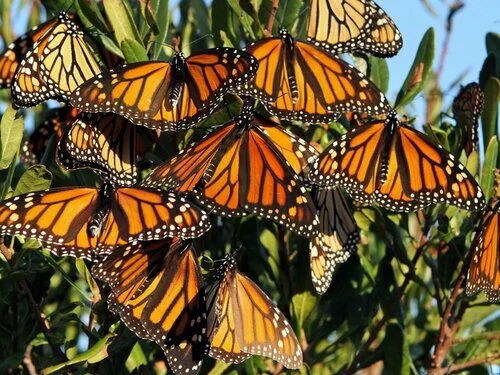
That was until, I looked up into a Eucalyptus tree to discover hundreds of monarch butterflies grouped together, their bright orange wings glistening in the sunlight.

I stood under the tree awestruck by their majesty, fully enraptured by the beauty of the present moment.

monarchs.jpg

The monarch butterflies that day seeded within me an unshakeable belief in the divine intelligence orchestrating all of life, and inspired in me a vision of global metamorphosis through cultural regeneration.

That day I experienced what psychologist & author Bill Plotkin calls an ‘eco-awakening’, where my worldview dramatically shifted to one in which I began to truly experience myself as a cell in the larger body of a living earth.

This communion with the butterflies inspired me to want to do something to help protect our earth, and to play a part in shifting perspectives around our relationship to one another and the natural world. I began to do deeper research on the climate crisis, and learn about the main drivers of environmental destruction. I had studied climate change/environmental studies in college, which prompted me to become vegetarian in 2012, and go mostly vegan a few years later. Thus, I was familiar with the climate crisis and had made changes to live more consciously in reciprocity with the earth, but I now felt re-invigorated and motivated to do more.

My past partner and I wanted to help tell the story of what was happening to the Amazon rainforest, so in the summer of 2017 we prepared to go down to the Brazilian Amazon to make a documentary about indigenous forest protectors of the Guajajara tribe, protecting their land from illegal logging. In preparation for the trip, I was feeling in over my head, and extremely anxious. I began to read a book called “The Work that Reconnects”, a powerful body of work developed by eco-philosopher, Buddhist scholar and elder Joanna Macy. ‘The Work that Reconnects’ propelled my ‘eco-awakening’, giving me rich language to describe my experience and desire for healing our world. It introduced me to a living systems framework and enlightening concepts and ideas such as mutual causality, deep ecology, the role of the bodhisattva, and Gaia theory. ‘The Work that Reconnects’ helped me to metabolize my anxiety, and brought me peace, courage & grace in a time of need. I was able to go down to Brazil feeling resourced and ready to learn, expand, and create something meaningful.

Nevertheless, the journey of creating the documentary triggered profound grief in me, which propelled my own journey of unravelling. We had travelled to a part of the Brazilian Amazon that had been decimated by industrial agriculture, and we spent hours driving on roads surrounded by rainforest burning in the distance, and cattle grazing on pasture that had very recently been standing virgin rainforest. I felt helpless in the face of what seemed like unstoppable destruction, fuelled by the powerful forces of cultural/american imperialism and extractive capitalism.

This experience changed me, and I returned home with more questions than answers, and plunged into a years long (really lifelong) process of reconciling my pain for the world and feelings of helplessness and hopelessness, with a desire to make a meaningful and positive impact on it.

A year later in 2018, I deepened into metamorphosis through the process of uncoupling from a 7 year partnership, which in turn led to a significant dissolution of who I thought I was. In the midst of uncoupling from my previous partner, I faced parts of myself that I had relegated to the shadows. Life had made it very clear that it was time for a reset. We had both developed coping strategies that were keeping us complacent, stuck in loops, and feeling victimized by our circumstances, the world, and by one another. I realize now how much I seeded my identity in our relationship, and how this identification created a false sense of security. I identified so deeply with the relationship that when life was asking us to let go of the comfortable cocoon we had created over so many years, I was terrified. I had no idea who I was outside of the life we had built together. I am grateful that through the process of our uncoupling, we shared a mutual commitment to do so with love and care. Thus, together we dove into the unbalanced dynamics that had developed over time and we went on a healing journey to learn how to own our own stuff & honestly communicate our feelings.

The last two years have been a process of coming home to myself. Along the way, I have made many mistakes. I have gotten involved with people when my intuition was telling me to be more restrained, and I’ve made choices that I now regret. At times, I’ve found it challenging to have healthy boundaries, and I’ve felt ungrounded and at a loss for what to do, and for how to ‘be’. I’ve gone through cycles of feeling alone, depressed, and entrenched in grief. Through this process, I’ve also delved into different spiritual practices, and as a result have had profoundly connective experiences. I’ve spent a lot of time inquiring into my own psyche, to in turn develop an internal process of self-compassion and self-acceptance. I’ve learned (and am continuing to learn!) how to get truly quiet so I can listen to ‘the little voice within’ so that I may trust and follow the natural wisdom that spontaneously arises. I’m grateful to now feel more at home in myself, settled in my body, connected to my heart, and to feel an eagerness to contribute meaningfully to the new story emerging.

I feel that I have undergone a metamorphosis over these years. I feel further along the path towards realizing my power and how I am positioned to make a positive impact in the world around me, and I am grateful to be on this forever-deepening path. In sharing my story within the frame of metamorphosis, I hope to convey my belief in the greater life intelligence at work in the world, and the value in taking a leap of faith and making big life changes. Change is inevitable and with it comes dissolution of identity, where we must relinquish so much of what we’ve known to be true about ourselves and reality, in order to make space for whatever is wanting to emerge.